Search Campaign Management
Dastify helps you build Google Search Ads for medical practices targeting high-intent searches related to treatments, symptoms, specialties, and local healthcare needs.
Without precise targeting, Google Ads budgets get wasted on low-intent traffic that never converts into appointments. We focus campaigns around high-intent patient searches, helping dental clinics, hospitals, and multi-location providers.


General PPC campaigns often target broad healthcare traffic instead of high-intent patient searches, leading to wasted ad spend and lower-quality leads.
Many agencies overlook HIPAA-compliant Google Ads tracking, creating privacy risks through improper conversion tracking and handling of patient data.
Healthcare advertising requires stricter accuracy standards because Google evaluates medical ads, landing pages, and claims more carefully than in other industries.
Healthcare landing pages need to address patient trust, insurance concerns, and clear next steps. Most agencies send paid traffic to generic pages that aren't built for healthcare conversions, leading to lower appointment rates and wasted ad spend.
Patients choose providers based on confidence, not just ads. YouTube builds trust visually through doctor introductions, clinic environment, and clear patient education.
Videos turn medical information into clear, relatable explanations. This reduces confusion and anxiety, especially in specialties like dermatology, orthopedics, mental health, and cosmetic care.
YouTube becomes the first touchpoint, warming audiences before they reach Search Ads. This improves engagement and conversion rates across the full patient funnel.
Patients choose providers based on confidence, not just ads. YouTube builds trust visually through doctor introductions, clinic environment, and clear patient education.
Videos turn medical information into clear, relatable explanations. This reduces confusion and anxiety, especially in specialties like dermatology, orthopedics, mental health, and cosmetic care.
YouTube becomes the first touchpoint, warming audiences before they reach Search Ads. This improves engagement and conversion rates across the full patient funnel.
We manage healthcare PPC services around how patients actually search, compare providers, and decide where to book care.

Dastify helps you build Google Search Ads for medical practices targeting high-intent searches related to treatments, symptoms, specialties, and local healthcare needs.

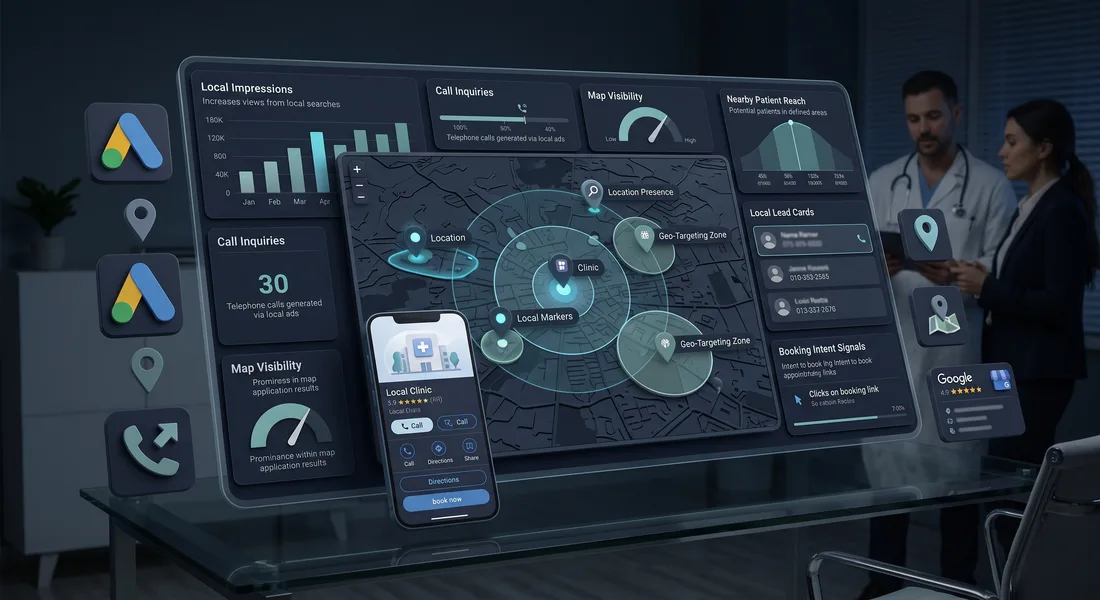
Our Google Ads for clinics improve visibility in nearby searches using geo-targeting, call extensions, location assets, and Google Business Profile integration.

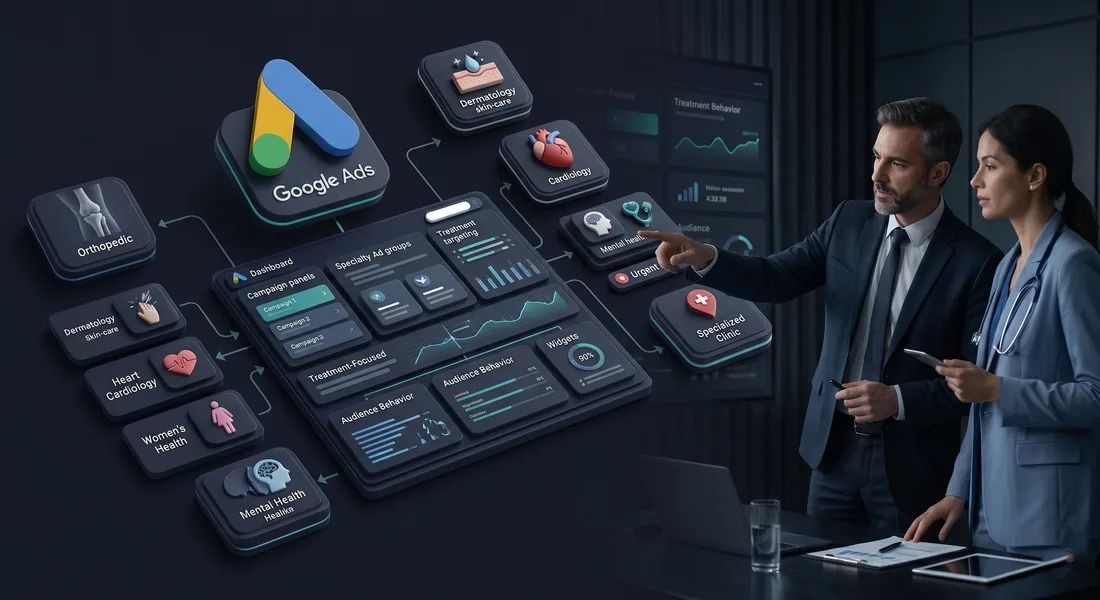
From cardiology and dermatology to psychiatry, orthopedics, OB/GYN, addiction treatment, and urgent care, campaigns are tailored around specialty-specific patient behavior.

We improve campaign structure, bidding, audience targeting, negative keyword management, and healthcare conversion rate optimization to reduce wasted spend.

Clear reporting through Google Analytics 4, Google Ads conversion tracking, and call tracking helps practices understand traffic quality and patient acquisition trends.
Discovery Ads help healthcare providers reach patients across Google surfaces like YouTube Home, Gmail, and Google Discover before they actively search for care.
Healthcare PPC performance depends heavily on structure, not just budgets. We organize campaigns based on how patients think, not what services look like internally.
Different healthcare specialties require different advertising strategies because patients' search behavior varies by the type of care being sought.
We support healthcare Google Ads for:

Gastroenterology Practices

Cardiology Clinics

Dermatology Practices

Orthopedic Groups

Mental Health Practices

OB/GYN Clinics

Urgent Care Centers
Most healthcare advertisers don't realize standard tracking can create compliance risks if Protected Health Information (PHI) is unintentionally shared through forms, URLs, or conversion events.
The Risk
Client-side tracking (like Google Tag Manager) can pass sensitive patient data directly to ad platforms. Under HHS guidance, this can raise HIPAA concerns for healthcare providers.
The Fix
We use server-side tracking for healthcare PPC, filtering sensitive data before sending conversion events to Google Ads for safe, compliant measurement.
Agreements
Advertisers using Enhanced Conversions or patient-related tracking may require Business Associate Agreements (BAAs) with vendors that handle data processing.
Analytics
We focus on accurate attribution without exposing patient data, ensuring tracking stays compliant while still delivering clear performance insights.
Call Compliance
Call tracking is set up to meet HIPAA and TCPA requirements, including two-party consent laws in states such as California, Florida, Illinois, and Pennsylvania — with secure routing and compliant disclosures.
Remarketing in healthcare must be carefully managed due to Google's sensitive-category policies. We do not build audiences based on medical conditions or diagnosis-related behavior.


Healthcare landing pages are one of the most critical factors in converting ad traffic into actual patient bookings. Unlike standard industries, medical landing pages must build trust instantly while reducing patient anxiety. We design landing pages around three core principles: clarity of service, visible trust signals (doctors, credentials, reviews), and friction-free booking pathways. Every landing page is structured to answer three patient questions immediately:
"Can I trust this provider?" "Do they treat my condition?" and "How do I book quickly?"

Insurance-based search intent is one of the strongest conversion signals in healthcare PPC because patients are not just looking for care, but care they can afford. We build campaigns around insurance-driven queries like coverage-based searches, "accepts my insurance" intent, and specific plan-related demand signals. This ensures ads reach patients who are both medically and financially ready to book care, improving conversion quality while reducing wasted spend.
Healthcare advertising on Google is governed by strict classification rules that determine what can and cannot be promoted.
Include services that require additional compliance checks before ads are approved.
Include misleading medical claims, unsafe treatments, and unsupported guarantees.
Include certain high-risk specialties that require verification before ads can run.

Negative keyword strategy is one of the most underrated drivers of healthcare PPC performance. We build specialty-specific negative keyword lists to filter out irrelevant traffic, such as job-related, research, free-treatment, and non-patient-intent queries. These lists are continuously refined using real search-term data. This keeps budgets focused only on high-intent patients ready to book care, not wasted clicks.
Performance Max can be powerful, but only when carefully controlled.

It provides cross-platform visibility across Search, Maps, YouTube, and Display, helping identify hidden patient behavior patterns.

Without controls, automated expansion may serve ads based on inferred health interests, creating compliance concerns.

We evaluate eligibility by specialty and activate Performance Max only with strict audience-signal controls and monitored automation layers.
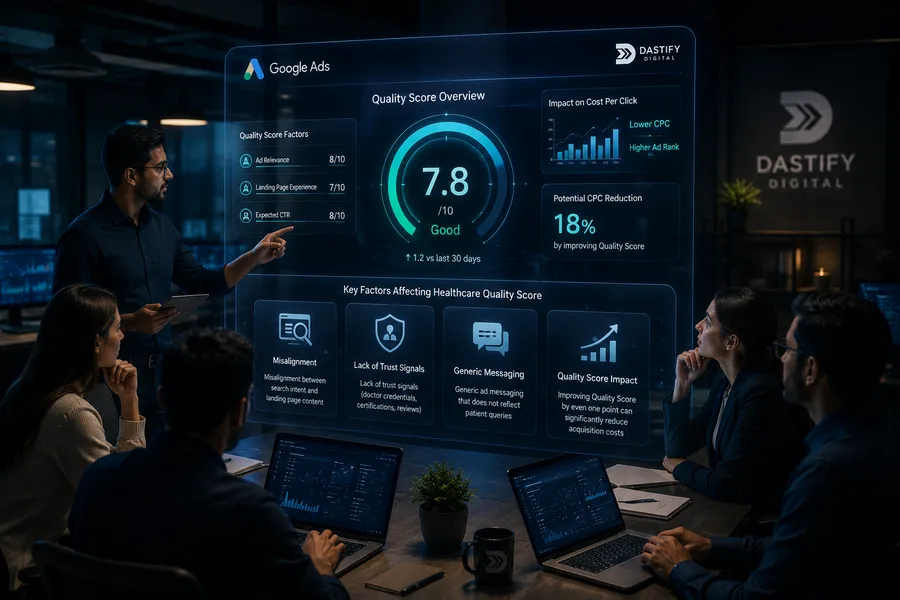
Quality Score directly impacts cost per click, but healthcare accounts often underperform due to structural issues.

Managing Google Ads internally often looks cost-effective, but performance tells a different story.
Healthcare advertising requires alignment with multiple regulatory layers.
Some healthcare advertisers cannot run Google Ads campaigns until proper verification is completed.
Google Local Services Ads help practices appear above traditional search ads for local healthcare searches. Healthcare advertising costs vary heavily by specialty, location, and competition.
Local Services Ads
LSAs can appear above traditional search ads, improving visibility for patients searching for providers in their area.
Local Services Ads
These campaigns prioritize direct patient calls and local inquiries rather than general website traffic.
Local Services Ads
Local services ads work especially well for practices competing within specific cities, regions, or service areas.
Cost Driver
High-demand specialties naturally face higher bidding costs across competitive markets.
Cost Driver
Weak pages reduce conversions even with strong traffic — driving up the real cost per patient.
Cost Driver
Higher-intent keywords consistently deliver better ROI than broad targeting.
A structured healthcare advertising process keeps campaigns measurable, scalable, and easier to manage internally.
We review campaign structure, conversion tracking, search terms, landing pages, ad spend allocation, and compliance risks.
Campaigns are built around specialty demand, patient intent, local competition, and acquisition priorities.
Google Business Profile integration, geo-targeting, location assets, and local healthcare visibility signals are optimized first.
Dastify Digital helps you improve your tracking accuracy, conversion attribution, Quality scores, landing page performance, and bidding efficiency.
Ad messaging, landing pages, provider credibility signals, FAQs, and patient trust elements are strengthened to improve conversion quality.
Performance tracking, ranking improvements, conversion insights, and search visibility reporting help maintain long-term growth momentum.
+240%
Increase in qualified patient inquiries
Top 5
Rankings for high-intent healthcare searches
3.8x
Growth in booked consultation requests
32%
Reduction in wasted ad spend through campaign optimization
1Problem
The practice was getting clicks from Google Ads, but very few were turning into actual patients. Most traffic came from broad or symptom-based searches, and users weren't moving forward to book appointments.
2Strategy
We shifted focus to high-intent patient searches and specific treatments, and aligned landing pages with real patient decision behavior — clear information, trust signals, and a simple booking flow.
3Solution
Campaigns were cleaned up, irrelevant searches filtered out, and landing pages simplified. Tracking was also refined to clearly separate real patient inquiries from general traffic.
4Outcome
The practice began receiving more qualified appointment requests, with a clearer and more direct link between ad spend and actual patient bookings.
For single-location practices launching healthcare PPC.
For practices serious about lowering cost per booked patient.
For multi-location groups & expanding healthcare organizations.
Healthcare ads require stricter compliance, trust-focused messaging, patient intent targeting, and safe, privacy-compliant tracking.
It uses server-side tracking that filters out Protected Health Information before sending conversion events to Google, so you can measure results without exposing patient data or risking HIPAA violations.
Addiction treatment providers, telehealth services, and online pharmacies typically must complete LegitScript or healthcare advertiser certification before Google will run their campaigns.
Most practices see early signals within the first few weeks, with meaningful improvements in qualified inquiries and cost per booked patient typically building over the first 60–90 days.
We align ad messaging with FTC, FDA, Google, and state medical board advertising rules — avoiding unsupported claims and guarantees while keeping copy truthful and patient-focused.
A 30-minute assessment with no obligation. We'll audit your current program and show you three places to move first.